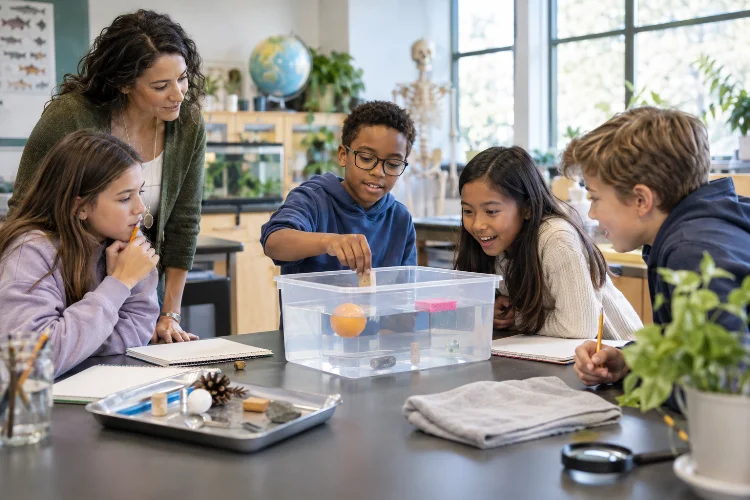
Imagine walking into a science classroom where the teacher does not begin by explaining why some objects float and others sink. Instead, students receive several objects, a container of water, and one question: “What determines whether something floats?”
Suddenly, the lesson feels different.
Students make predictions, test objects, compare results, argue about their ideas, and begin looking for patterns. The teacher is still involved, but instead of immediately providing the answer, they guide students toward discovering and explaining it.
That is the basic idea behind Inquiry-Based Learning.
Rather than treating students as passive receivers of information, this approach encourages them to investigate questions, gather evidence, develop explanations, and reflect on what they discover.
It is closely connected to active learning, problem-solving, and critical thinking. But inquiry does not simply mean telling students to “figure it out themselves.” Effective inquiry requires careful planning and appropriate teacher support.
So, how does inquiry-based learning actually work in a real classroom?
What Is Inquiry-Based Learning?
Inquiry-based learning, often shortened to IBL, is a student-centered approach where learning develops through questions, investigation, evidence, and reflection.
Instead of beginning every lesson with an answer, teachers create opportunities for students to explore a problem or question.
Queen’s University describes inquiry-based learning as classroom practices that move students through guided and increasingly independent investigation of complex questions and problems.
Learners develop skills such as asking useful questions, finding information, evaluating evidence, and communicating conclusions.
That does not mean facts suddenly become unimportant.
Students still need background knowledge. The difference is that they actively use that knowledge to investigate something meaningful.
A history class might ask why an empire collapsed. A biology class might investigate which conditions affect plant growth. A geography class could examine why flooding affects certain neighborhoods more severely than others.
The question becomes the starting point for learning.
How the Inquiry Learning Process Works
Inquiry does not always follow one rigid formula, but several stages appear regularly.
1. It Starts With a Question
Good inquiry usually begins with curiosity.
The teacher might provide the original question, or students may develop their own. Beginners often benefit from more structure, while experienced learners can handle greater independence.
The question should require more than recalling a fact.
“What’s the boiling point of water?” can be answered quickly. “How does atmospheric pressure affect the temperature at which water boils?” creates much more room for investigation.
2. Students Investigate
Next comes exploration.
Students may conduct experiments, analyze documents, interview people, research sources, collect measurements, or examine existing data.
During this stage, they are not simply looking for the teacher’s preferred answer. They are gathering information they can use to develop an explanation.
3. Evidence Leads to Conclusions
The inquiry process becomes meaningful when students connect evidence with claims.
The National Academies’ framework for science education emphasizes activities such as asking questions, conducting investigations, analyzing data, constructing explanations, and arguing from evidence.
Students may even discover that their original idea was wrong.
That is not failure. Revising an explanation after encountering better evidence is an important part of learning.
What Does the Teacher Do During Inquiry?
One common misconception is that inquiry-based learning removes the teacher from the lesson.
It actually changes the teacher’s role.
Instead of providing every answer immediately, the teacher designs the learning enviroment, chooses appropriate problems, provides resources, observes student thinking, and asks questions that move the investigation forward.
For example, students struggling with an experiment might hear:
“What pattern do you notice?”
“What evidence supports that idea?”
“What could you test next?”
These questions provide direction without solving everything for them.
Teacher guidance is especially important for beginners. A meta-analysis covering 72 studies found that guidance during inquiry had positive effects on learning activities, successful performance, and learning outcomes.
So effective inquiry is not the same as minimal teaching.
Students need freedom to think, but they also need support.
Structured, Guided, and Open Inquiry
Not every inquiry lesson gives students the same amount of independence.
In structured inquiry, the teacher may provide the question, procedure, and materials. Students conduct the investgation and use the results to develop explanations.
In guided inquiry, the teacher provides the main question but gives students more control over how they investigate it.
With open inquiry, students may formulate their own questions, choose methods, collect evidence, and develop conclusions more independently.
These approaches can exist on a continuum.
Queen’s University notes that inquiry can range from teacher-provided questions and data to situations where learners determine their own questions and decide what evidence needs to be collected.
A beginner class does not need to jump directly into open inquiry.
Teachers can gradually reduce support as learners gain confidence.
What Inquiry-Based Learning Looks Like in Practice
Consider a middle-school lesson about local water quality.
A traditional lesson might begin with a presentation about pollution, pH levels, and aquatic ecosystems.
An inquiry lesson could begin differently:
“Is the water in our local area healthy enough to support aquatic life?”
Students might examine samples, measure water characteristics, research possible pollutants, compare locations, and discuss how their findings should be interpreted.
The teacher could provide measurement techniques and safety instructions while allowing students to make decisions about how the evidence should be organized.
At the end, students might present conclusions and defend them using collected data.
The Smithsonian Science Education Center describes inquiry-based science in a similar way: students investigate problems, make observations, ask questions, test ideas, develop explanations, and evaluate their understanding using evidence.
Notice that students are still learning scientific content.
They are simply learning it through investigation rather than only receiving it through explanation.
Why Inquiry-Based Learning Can Be Effective
Inquiry can make learning more intellectually active.
Students are asked to analyze information, compare possibilities, explain reasoning, and solve problems rather than simply remember what the teacher said.
It can also help learners see why knowledge matters.
A formula may feel abstract when presented on a board. The same formula can become meaningful when students need it to solve a real problem.
Research provides encouraging evidence, although results depend heavily on implementation.
A second-order meta-analysis published in 2022 synthesized 10 previous meta-analyses and reported an overall medium positive effect of inquiry-based learning on learning outcomes, with an effect size of d = 0.62.
Inquiry is also commonly associated with skills such as critical thinking, information evaluation, research, communication, and problem-solving.
The Smithsonian Science Education Center highlights its value for investigation, evaluating evidence, reasoning, and building evidence-based conclusions.
That makes the approach especially relevant when students need to do more than memorize content.
Common Problems With Inquiry-Based Learning
Inquiry can fail when students are given too much independence too quickly.
Imagine telling beginners, “Research climate change and explain what is happening.”
The topic is enormous. Students may not know which sources are trustworthy, what information matters, or how to organize their investigation.
A better approach might provide a focused question, several reliable starting resources, and clear criteria for evaluating evidence.
Another problem occurs when the activity becomes interesting but the learning goal disappears.
Students can spend an hour building, experimenting, or discussing while learning very little if the activity is poorly connected to the concept being taught.
This is why planning matters.
Teachers should know what students are expected to understand, what evidence could demonstrate that understanding, and what support may be needed during the process.
Research on inquiry consistently suggests that guidance matters. Inquiry becomes stronger when teachers provide appropriate scaffolding rather than assuming students will discover everything independant of instruction.
How Teachers Can Use Inquiry More Effectively
Teachers do not need to redesign every lesson around open-ended projects.
A small inquiry activity can be enough.
Instead of explaining a pattern immediately, present students with examples and ask what they notice. Before demonstrating an experiment, ask them to predict the outcome and explain their reasoning.
The National Academies recommends teacher guidance that includes selecting relevant phenomena, helping students develop meaningful questions, setting expectations for evidence, supporting explanations, and facilitating productive classroom discussion.
Teachers should also match the level of freedom to student readiness.
Beginners may need clear procedures and targeted questions. More experienced students can gradually take responsibility for designing methods and evaluating resources themselves.
Reflection is useful too.
After an inquiry activity, students can ask themselves what they originally believed, what evidence changed their thinking, and what questions remain.
That final step helps turn an interesting activity into actual learning.
Understanding how inquiry-based learning works means recognizing that good inquiry is not simply about letting students explore without direction.
It is a structured process where questions lead to investigation, evidence leads to explanation, and reflection helps students refine their understanding.
Teachers remain essential by designing meaningful problems, providing appropriate scaffolding, asking productive questions, and helping learners evaluate evidence.
When used well, inquiry can make students more active participants in their education while developing critical thinking, problem-solving, research, and communication skills.
Teachers do not need to transform every lesson overnight. Start small.
Take one topic you normally explain immediately and turn part of it into a question students can investigate. Their curiosity may become one of the most useful teaching tools in the classroom.