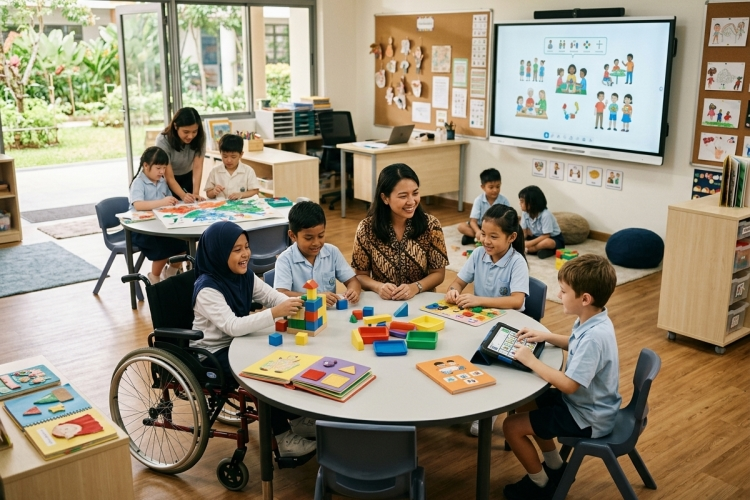
Imagine a classroom where every student is physically present, but only some can truly participate. One learner cannot read the small text on the board, another does not understand the language used in the lesson, and a third is regularly excluded from group activities.
Being in the same room is not always the same as being included.
So, what is inclusive education? Inclusive education is an approach that gives all learners meaningful opportunities to attend school, participate in lessons, build relationships, and achieve their potential.
It recognises that students have different abilities, languages, cultures, identities, economic circumstances, and learning needs. Instead of expecting every learner to fit one fixed system, inclusive education asks schools to identify and remove barriers.
These barriers may exist in buildings, teaching methods, curricula, assessments, attitudes, or school policies. UNESCO describes inclusion as a process of transforming education systems so that all learners are valued and supported.
The goal is not simply to place excluded students in ordinary classrooms, but to make the entire learning environment work better for everyone.
What Inclusive Education Really Means
Inclusive education means that students learn together wherever possible and receive the support they need to participate successfully.
No learner should be excluded because of disability, gender, language, ethnicity, religion, social background, poverty, migration status, or another personal characteristic.
The idea is broader than special education. Learners with disabilities are an important part of the discussion, but inclusion also concerns children who experience discrimination, displacement, language barriers, geographical isolation, or economic disadvantage.
A genuinely inclusive school does not assume that all students must learn in exactly the same way. It provides different routes towards shared and meaningful learning goals.
For example, students may study the same historical event through written texts, audio recordings, images, teacher explanations, and group discussion. The learning objective remains important, but the way learners access and demonstrate their knowledge can vary.
UNESCO explains that educational inclusion covers the removal of barriers across curricula, teaching, participation, and the wider education system.
Inclusion Is Different From Integration
The words inclusion and integration are sometimes used as though they mean the same thing. However, they describe different approaches.
Integration usually places a learner within an existing mainstream school or classroom. The student is expected to adjust to the programme, teaching style, timetable, and assessment system that are already in place.
Inclusion goes further. It asks the school to change when existing practices prevent a student from participating or learning.
Imagine a student who uses a wheelchair. Integration might mean admitting the student to the school. Inclusion would also require accessible entrances, suitable classroom layouts, safe toilets, participation in school activities, and teachers who understand how to provide appropriate support.
The same principle applies to learning. Giving a student with a visual impairment the same printed worksheet as everyone else may appear equal, but it is not inclusive if the student cannot read it.
Providing a digital version compatible with a screen reader gives the learner a fair opportunity to complete the same meaningful task.
Why Inclusive Education Matters
Education is a human right, not a reward reserved for students who fit a particular system.
Article 24 of the United Nations Convention on the Rights of Persons with Disabilities recognises the right to an inclusive education system without discrimination and on the basis of equal opportunity.
Inclusion also creates a stronger sense of belonging. Students are more likely to participate when they feel respected, safe, and recognised as genuine members of the school community.
Learning together can help children encounter people with different experiences, abilities, languages, and perspectives. This can reduce harmful stereotypes and encourage cooperation, patience, and empathy.
Inclusive education may benefit students without identified disabilities as well. Clear explanations, accessible materials, predictable routines, flexible practice, and multiple ways of presenting information can make learning easier for an entire class.
UNICEF describes inclusive education as an effective way for children with disabilities and other excluded learners to develop the knowledge and life skills they need.
It also notes that these children continue to face barriers caused by stigma, discrimination, and education systems that do not respond adequately to their needs.
What an Inclusive Classroom Looks Like
An inclusive classroom is not defined by one special resource or teaching technique. It is created through many small decisions about communication, participation, materials, expectations, and support.
Teachers begin by getting to know their students. They identify prior knowledge, strengths, interests, communication needs, and possible barriers before planning instruction.
1. Flexible Teaching and Learning
A teacher may explain a concept verbally, provide a diagram, demonstrate an example, and allow students to discuss it with a partner. This gives learners several ways to engage with the same idea.
Students may also demonstrate understanding through different formats when those formats match the learning objective. A learner could write an explanation, record an audio response, give a presentation, or build a model.
Flexibility does not mean removing academic challenge. The purpose is to remove unnecessary obstacles while maintaining meaningful expectations.
2. Reasonable Support
Some learners need additional or specialised support. This may include assistive technology, sign-language interpretation, Braille materials, extra processing time, communication tools, individual learning plans, or help from trained specialists.
Support should enable participation rather than separate learners automatically. UNICEF guidance emphasises that children with disabilities should not merely be present in educational activities; they should be able to participate fully and make progress.
Common Barriers to Inclusive Education
One of the biggest barriers is attitude. Teachers, parents, or community members may assume that certain students cannot learn, will slow down the class, or belong in a separate institution.
These low expectations can become more limiting than the learner’s actual condition. Students need appropriate support, but they also need adults who recognise their potential.
Physical access remains another challenge. Stairs, narrow entrances, inaccessible toilets, poor lighting, and unsuitable transportation can prevent students from attending or moving safely around school.
Teaching materials can create barriers too. A textbook may use unnecessarily complicated language, a video may lack captions, or an online platform may not work with assistive technology.
Schools may also lack trained teachers, reliable information about students’ needs, funding, or access to specialists. UNICEF has identified insufficient teacher preparation, incomplete data, and negative attitudes among the challenges affecting children with disabilities in Indonesia.
Inclusive education therefore requires more than goodwill. Schools need practical resources, professional development, leadership, and policies that support implementation.
How Teachers Can Make Learning More Inclusive
Teachers do not need to create a completely different lesson for every student. They can begin by designing lessons that are flexible enough to serve a wider range of learners.
Instructions should be clear and divided into manageable stages. Important information can be presented through speech, text, images, examples, and demonstrations.
Teachers should also check understanding across the whole class. Asking “Does everyone understand?” rarely provides reliable evidence. Short written responses, practical demonstrations, or conversations can reveal who needs additional explanation.
Group work should be organised carefully so that every student has a meaningful role. Simply placing learners together does not guarantee participation, especially when confident students control the task.
Feedback should focus on progress and practical next steps. Teachers can maintain high expectations while adjusting the support, time, or tools students use to reach the goal.
Most importantly, learners and families should be included in decisions. They often understand the barriers they experience and can explain which forms of support are genuinely useful.
Inclusion Requires Change Across the Whole School
Individual teachers play a major role, but they cannot create inclusive education alone. School leaders and education systems must provide suitable conditions.
Buildings need to be accessible, learning materials must be available in appropriate formats, and teachers require regular training. Assessment policies should also allow students to demonstrate learning without facing irrelevant barriers.
The World Bank argues that disability inclusion should be built into wider education reform through legislation, flexible curricula, suitable assessment, teacher support, and effective school leadership.
Community involvement matters as well. Families, organisations of persons with disabilities, students, educators, and local leaders should participate in planning and reviewing inclusive policies.
Recent World Bank initiatives have combined teacher training, accessible learning environments, community awareness, and targeted support rather than relying on one isolated intervention. This reflects the need for system-wide change.
Inclusive Education Is a Continuing Process
No school becomes completely inclusive after installing a ramp or holding one teacher-training session. Learners and circumstances change, so schools must continue identifying and removing barriers.
Schools can review attendance, participation, achievement, disciplinary action, and student feedback to understand who may still be excluded. Data should be examined carefully because average results can hide the experiences of smaller groups.
Leaders should also ask students directly whether they feel safe, respected, and able to participate. A school may appear inclusive in its official policy while everyday practices tell a different story.
Progress often begins with manageable improvements. A school might add captions to videos, revise an inaccessible assessment, improve classroom layouts, or create a clearer process for requesting support.
Inclusive education is therefore not a finished product. It is an ongoing commitment to making education more equitable, responsive, and welcoming.
Inclusive education gives every learner a genuine opportunity to access school, participate in learning, develop relationships, and achieve meaningful goals. It is not simply about placing different students in the same classroom.
Real inclusion requires schools to remove physical, social, instructional, and institutional barriers. Teachers need flexible methods, accessible materials, appropriate support, and high expectations for every learner.
Education systems must provide training, resources, leadership, and policies that make these practices sustainable. Start by examining one classroom, course, or school activity.
Ask who can participate easily, who faces obstacles, and what small change could improve access. Inclusion grows when educators stop asking learners to fit the system and begin designing a system that welcomes human diversity.